

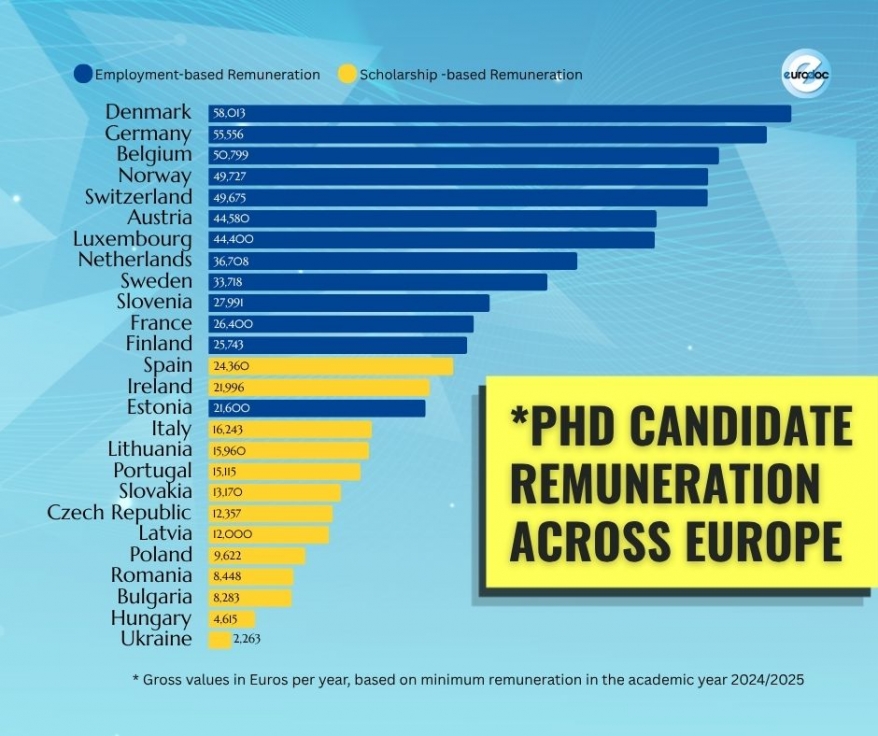
The European Council of Doctoral Candidates and Junior Researchers (Eurodoc) presents a comprehensive overview of remuneration levels that doctoral candidates can expect in various European countries. The current data collection, believed to be the first of its kind, surveys representative compensation levels in 27 countries.
With the data, Eurodoc aims to support a dialogue on the importance of appropriate financial and systemic support for early-career research careers. The data are of interest to both policy makers and individuals, not least prospective doctoral researchers. "We hope that this collection can serve as a reference for our 31 member organisations working in 26 European countries, particularly for those where minimum guaranteed salaries or scholarships fall far short of the average", says Norbert Bencze, President of Eurodoc and one of the five authors behind the report.
“Collecting comparative data on remuneration across Europe is notoriously difficult, but important to monitor to ensure the attractiveness of the European research system”, continues Bencze. “By publishing these data, our aim is to draw attention to the significant disparities in doctoral remuneration across Europe and to encourage similar data collection — ideally in more detailed form.”
This report serves as a baseline for understanding these differences and for advocating for improvements in doctoral career sustainability and attractiveness. Eurodoc has long worked on the economic situation for early career researchers across Europe, and maintains that the salary for doctoral researchers in Europe should at least be comparable to that of an upper secondary school teacher. These are also highly educated and mostly publicly employed professionals. However, in most countries, this remains far from the reality. The lowest figures were noted for Ukraine and Hungary, where the remuneration amounted to only 2,263€ and 4,615€ a year, respectively. These numbers are a far cry from the highest figures, with Denmark sitting at 58,014€ a year and Germany at 55,557€. The report acknowledges, however, that most doctoral candidates in Germany are employed on part-time contracts.
Failing recognition of the professional work of doctoral researchers and lacking appropriate compensation remain a major challenge to European research competitiveness. Madeline Jane Quill and Emma de Brabander jointly coordinate Eurodoc’s Working Group on Employment and Labour Conditions. They highlight that: “Across Europe, early career researchers are hit hard by the cost of living and housing crisis. This particularly affects doctoral researchers in some Central and Eastern European countries where current scholarship levels put them below the European at-risk-of-poverty threshold.” This summer, the working group prepared a report on the financial conditions of doctoral candidates. The contractual status of doctoral candidates – as students or employees – has impacts beyond the remuneration, affecting also social security and worker rights.
The full dataset, along with a complete list of official sources, is now available. It covers 27 of the 46 member states of the Council of Europe, with data in the remaining countries either unavailable, too unreliable, or systems too fragmented to present a meaningful average at the state level. Eurodoc will continue to monitor developments and plans to update the dataset in the future.
Eurodoc hopes the report will encourage others to monitor remuneration developments and to look beyond salary levels alone – at social security coverage, pension entitlements, paid leave, and other conditions that make doctoral careers genuinely sustainable. Only with reliable data can policymakers and institutions make informed decisions about how to best support their doctoral researchers.
“We are deeply grateful to all the people who contributed to this report over the last two years: researchers, institutional contacts, and national organisations who provided data, verified sources, and offered insights”, Bencze concludes, on behalf of the team of authors.
Read the full report here.