

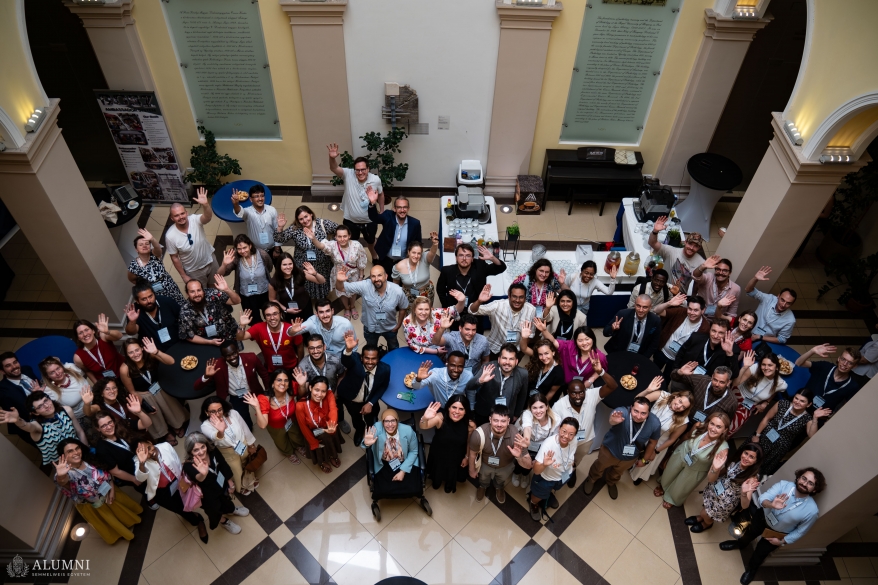
The Eurodoc Annual Conference 2026 took place on 24–25 June in Budapest, at Semmelweis University's Department of Pathology and Experimental Cancer Research, followed by the Eurodoc Annual General Meeting on 26–27 June. The event, titled Early Career Researchers as Ambassadors for Science and Society, was organised by Eurodoc and DOSZ, with Semmelweis University as host institution. More than 120 participants from over 20 countries took part across the four days.
The conference opened with welcome remarks from the presidents of both organisations and representatives of the Hungarian academic and research policy community. Enikő Kubinyi, Deputy State Secretary at the Ministry for Science and Technology, also addressed the opening session, reflecting on her own research career and acknowledging the pressures facing early-career researchers, while outlining Hungary's commitment to making research careers more attractive. Her presence marked an important connection between the doctoral researcher community and those shaping science policy at the national level.
The first day centred on the policy landscape surrounding the European Research Area. Thomas Sturm (Universitat Autònoma de Barcelona) opened with a keynote on the Fifth Freedom — the free circulation of knowledge — and the practical barriers that still prevent its full realisation for early-career researchers. Two panel discussions followed: one exploring researcher mobility as systemic infrastructure rather than individual opportunity, the other bringing together data on career trajectories, wellbeing and employment conditions from the OECD's Reico Observatory and the Hungarian Young Academy. The day closed with Magda de Carli from the European Commission's Directorate-General for Research and Innovation, who outlined the policy tools expected from the ERA Act and the role ECR organisations are meant to play in implementation.
The second day put practice at the centre. Eurodoc's member organisations shared experiences and good practices across sessions on academic governance, research community building, and doctoral reform. Presentations came from Italy, Norway, Ireland, Poland, Czechia, Germany, Spain, Ukraine and Hungary, among others — a genuine cross-section of where doctoral education in Europe stands today. In the afternoon session organised by DOSZ, the DOSZ Ambassador Programme was presented as a good practice for supporting the integration and community involvement of international doctoral researchers in Hungary, alongside the Eurodoc ValDem Programme, PeerPower, and the Polonium Foundation's diaspora network.
Three parallel workshops concluded the programme: on using AI responsibly in research and proposal writing, on validating doctoral research as a potential startup or spin-off, and on research career frameworks and advocacy strategy for national associations. The conversations across all three rooms were among the most engaged of the conference. In the evening, participants joined a guided tour of the Buda Castle district, followed by a standing reception at the Hungarian National Gallery.
The discussions throughout were substantive and the feedback we received was overwhelmingly positive. Participants came ready to engage, and the exchange between national associations, across very different research systems and national contexts, was exactly the kind of dialogue this conference is meant to create. Thank you to everyone who took part, and to all the organisers and volunteers who made it work.